
Atrial fibrillation (A-fib) is a type of arrhythmia (irregular and typically fast heartbeat) that can cause blood clots in the heart. Stroke, heart failure, and other heart-related problems are all increased by A-fib.

Atrial fibrillation is a condition that can be quite frightening when diagnosed. It is common for people to fear something ominous when their heart acts up. The heart’s beating, pulse rate, and ability to function well as a pump can be affected by many things. This page explains atrial fibrillation, a common reason for heart irregularities. If you have arrhythmia, this page will help you understand that there is nothing to fear, and how fear itself can contribute to atrial fibrillation.

Atrial fibrillation, or AF, is the most common type of irregular heart beating. It is also called arrhythmia, which is a problem with the rate or rhythm of the heartbeat. During an arrhythmia, the heart can beat too fast, too slow, or with an irregular rhythm. This can cause you to feel that there is “something not right” when your heart beats at times. This may be more noticeable when you lay down, at rest, or after exertion, as it may take longer for the heart to settle into a steady rhythm.
Atrial fibrillation may happen rarely or frequently, or it may become a long-term condition. Some people with AF may not feel symptoms. However, even when AF isn’t noticed, it can increase the risk of stroke. In some people, AF can cause chest pain or heart failure, especially if the heart rhythm is very rapid.
There are no hard and fast rules with AF; each patient experiences it differently. AF may be brief with symptoms that come and go, or it may be ongoing and require treatment. Rarely, AF is permanent, and even medications and surgery may not restore a normal heart rhythm. However, most people with AF can live normal, active lives. Natural medicine treatment can restore normal heart rhythms for some, while others may need medications and lifestyle changes to manage symptoms and prevent complications.
A healthy heart has a slow, deep, and regular pulse rate, typically between 40 and 70 beats per minute. With arrhythmia, the pulse rate may vary more than usual, feeling like a racing heart at times and slow and irregular at other times. AF can cause the heart to beat at very fast rates, which can be scary. Arrhythmia is more noticeable at rest than during exertion.

Atrial fibrillation can be thought of as irregular power surges in the heart. The heart maintains a steady rhythm due to tiny electrical discharges:
1. SA Node: This tiny electrical signal starts in the sino-atrial (SA) node at the top of the right atrium. The SA node sends out signals 50 to 100 times per minute.
2. Atria: The signal travels from the SA node to the right and left atria, causing them to contract and pump blood into the ventricles.
3. AV Node: The signal then moves to the atrio-ventricular (AV) node, which slows the signal, allowing the ventricles to fill with blood.
4. Ventricles: The signal travels to the ventricles, causing them to contract and pump blood to the lungs and the rest of the body.
5. Relaxation: The ventricles relax, and the heartbeat process starts over. Stress can disrupt this process, making the SA node less reliable.
Atrial fibrillation occurs when rapid, disorganized electrical signals cause the atria to “fibrillate” or contract very fast and irregularly. Blood pools in the atria and isn’t pumped completely into the ventricles, causing the upper and lower chambers to work uncoordinatedly. The ventricles may beat 100 to 175 times a minute, compared to the normal 60 to 100 beats per minute.
AF may occur without underlying heart disease and can be more common in younger people without other heart problems. AF is caused by damage to the heart’s electrical system, often due to conditions like high blood pressure and coronary heart disease. The risk of AF increases with age and inflammation.
– Hyperthyroidism
– Caffeine
– Alcohol consumption
– Sleep apnea
– Metabolic syndrome
– Steroids
– Pulmonary embolism
– Pneumonia
– Stress
– Inflammation and oxidative stress
– Heart valve disease
– Enlargement of the left ventricle walls
– Coronary heart disease
– High blood pressure
– Cardiomyopathy
– Sick sinus syndrome
– Pericarditis
– Post-heart surgery (usually resolves within days)
 Phil was a most interesting case (not his real name). This man runs a very successful NZ company and is the managing director in charge of several hundred staff in Auckland. His company has amassed literally a fortune over the years but at a huge personal cost, Phil has been married and divorced twice and declared bankrupt only a few years ago but managed to climb back to the top of his game. Phil would have to be one of the most anxious, irritable and stressed patients I have encountered in over twenty years of practice. He couldn’t even sit down for five minutes during his consultation with me and appeared very impatient and irritable as he paced the floor continually, answering his mobile phone.
Phil began to tell me that he had been to France twice for an operation (over 200K NZ dollars a time) to his heart in order to resolve his atrial fibrillation. Phil mentioned that it was “all a waste of time” because he still suffered from a very irregular heartbeat at times which was literally driving him to despair. This driven man really believed that his AF could be easily resolved with an operation and that he could go back to his regular (and highly stressed) lifestyle as if nothing had ever happened. I only ever say Phil once, he left my room in disbelief and with some urgency and I’ve wondered at times what ever became of him, and whether he is even still alive. The incredible thing is that if Phil learned to relax properly and developed more of a balance between work and play (and started to understand the connection between mind-body connection more) then there would be no more need for expensive and time-wasting operations. His condition would have resolved all by itself.
Now you will be thinking: “How could Eric know that”, well I can tell you right now, it’s not that difficult to connect a person’s chronic health complaint with the way they think and behave, and the way Phil was behaving I was quite surprised that he even made it to sixty three years of age. You don’t need a medical degree nor a crystal ball to see into the future for patients like Phil, you just need an ounce of common sense to understand that nobody gets away with living like that for too long without some major health problem coming their way. And in Phil’s case it was his heart, making me wonder how happy he really was in life. Some people just throw themselves into their work when they are unhappy, others will eat food and yet others will have addictions such as booze or gambling.
I’m not suggesting that all cases of AF are as a result of living a highly stressed lifestyle, but from the several cases I have seen over the years I could safely say that about half are as a result of a highly strung individual living their life on a razor’s edge. My wife’s girlfriend Shirley (not her real name) is another example of AF induced by stress. Shirley separated from her husband and is undergoing a divorce at present. Her husband left her due to her obsession and extreme competitiveness with her business. She ended up in the emergency ward only a few weeks ago with major arrhythmia after she received a lawyer’s letter outlining the terms of their separation. Her doctor recently diagnosed Shirley as having atrial fibrillation and recommended drugs.
1. Paroxysmal AF: Short, frequent symptoms that stop on their own within a week, often in less than a day.
2. Persistent AF: Abnormal heart rhythm continues for more than a week and may require treatment to stop.
3. Permanent AF: Normal heart rhythm can’t be restored with treatment.
Men are more at risk than women, and AF is uncommon in children. The risk increases with age, as does the risk for heart disease and other conditions that cause AF. About half of people with AF are younger than 75.
Just like any other condition, some people are more at risk than others. Here is a list of the common AF risk
Common AF risk factors include:
– High blood pressure
– Coronary heart disease
– Heart failure
– Rheumatic heart disease
– Heart defects
– Pericarditis
– Congenital heart defects
– Sick sinus syndrome
Oxidative stress is a significant risk factor for AF. Researchers at Emory University found that higher oxidative stress levels predict AF risk. This stress can enlarge the heart’s left atrium, a major cause of AF.
AF symptoms can be subtle at first and intensify over time:
– Palpitations
– Shortness of breath
– Weakness
– Chest pains
– Dizziness or fainting
– Fatigue
– Confusion
– Stroke: Blood pooling in the atria can form clots, which can travel to the brain and cause a stroke.
– Heart failure: AF can weaken the heart, leading to heart failure.
During AF, the heart’s upper chambers (atria) don’t pump all of their blood to the ventricles (bottom chambers). This causes some blood to pool in the atria, potentially forming a blood clot (thrombus). If a clot breaks off and travels to the brain, it can cause a stroke. Blood clots that travel to different parts of the body are called emboli. Blood-thinning drugs like Warfarin reduce the risk of stroke, though natural medicines such as Nattokinase and Omega-3 can also be effective.
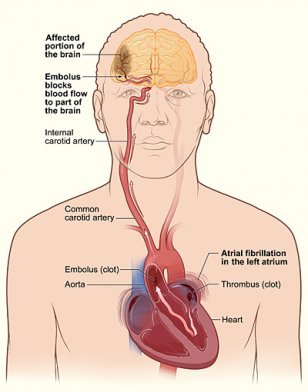 A blood clot can form in the left atrium of the heart. If a piece of the clot breaks off and travels to an artery in the brain, it can block blood flow, causing a stroke. This blockage deprives brain tissue of oxygen, leading to tissue death.
Your heart functions as a mechanical pump, and heart failure occurs when it can’t pump enough blood to meet your body’s needs. AF can lead to heart failure because the ventricles beat very fast and can’t completely fill with blood. This prevents sufficient blood from being pumped to the lungs and body.
y.
– Fatigue and shortness of breath (due to fluid buildup in the lungs)
– Oedema (fluid retention) in the feet, ankles, and legs, causing puffiness and weight gain
Treatment includes lifestyle changes, drugs, and procedures or surgery. In severe cases, a mechanical heart pump or heart transplant may be necessary.
AF is diagnosed based on your medical and family history, a physical examination, health habits, and results from various tests and procedures.
Medical and Family History:
– Does anyone in your family have a history of AF, heart disease, high blood pressure, or thyroid problems?
– Is there a family history of diabetes or other health problems?
Physical Examination:
– What signs and symptoms do you have? (e.g., palpitations, dizziness, shortness of breath, swollen feet or ankles, chest pain)
– A complete cardiac exam, including listening to your heartbeat, pulse, and blood pressure
– Checking for heart muscle or valve problems, lung issues, and swelling in your legs or feet
– Checking for an enlarged thyroid gland or signs of hyperthyroidism
Health Habits:
– Do you smoke or use alcohol or caffeine?
– Are you carrying excess weight or do you have metabolic syndrome?
Diagnostic Tests:
– EKG: Records the heart’s electrical activity and is the most useful test for diagnosing AF.
– Portable EKG Monitor: Used to diagnose paroxysmal AF by recording your heartbeat over several days.
– Heart Stress Test: Diagnoses heart problems when the heart is working hard and beating fast.
– Echocardiography: Uses sound waves to create a moving picture of the heart, showing its size, shape, and function.
– Chest X-Ray: Can show fluid buildup in the lungs and signs of other AF complications.
– Blood Tests: Check the levels of thyroid hormone and electrolytes like magnesium, potassium, and sodium.
AF treatment depends on the frequency and severity of symptoms and any underlying heart disease. Treatment options include pharmaceutical drugs, medical procedures, and lifestyle changes.
Goals of AF Treatment:
– Preventing blood clots (reducing stroke risk)
– Controlling the rate of ventricle contraction (rate control)
– Restoring a normal heart rhythm (rhythm control)
– Treating underlying conditions (e.g., hyperthyroidism)
Blood Clot Prevention:
– Blood-thinning medicines (e.g., Warfarin, Heparin, Aspirin)
Rate Control:
– Medicines to slow down ventricular rate (e.g., beta-blockers, calcium channel blockers, digitalis)
Rhythm Control:
– Drugs or procedures to restore normal heart rhythm (e.g., amiodarone, sotalol)
– Catheter ablation to destroy the AV node, requiring a pacemaker
Natural Treatments:
– Magnesium: Important for heart cell function. Start with 400-600 mg daily, increasing to 800 mg in divided doses.
– Epsom Salts Bath: 20-minute soak with two cups of Epsom salts.
– Calcium: Avoid taking calcium supplements alone; balance with magnesium.
– Potassium: Take 1600-2400 mg daily to maintain heart rhythm.
Preventing Atrial Fibrillation:
– Follow a heart-healthy diet (low in saturated fat, trans fat, and cholesterol)
– Eat a variety of whole grains, fruits, and vegetables
– Avoid smoking
– Be physically active
– Maintain a healthy weight
– Manage existing heart disease or risk factors
For more detailed information on atrial fibrillation, visit:
– ScienceDaily: Measuring Oxidative Stress and AF Risk
– MedlinePlus: Atrial Fibrillation
– Clinical Trials and Current Research
This comprehensive guide aims to provide valuable insights into atrial fibrillation, its diagnosis, treatment, and prevention. If you have any concerns, consult your healthcare provider for personalized advice and treatment options.